 What clues early in humanity’s search of the sky told the Universe’s story? Emerging from the darkness long ago, what diffuse beacons in the fabric of spacetime offered a glimpse into our place in the cosmos?
When Galileo first pointed his telescope at Jupiter and saw its moons he inevitably would have looked at other parts of the sky. He would have noticed fuzzy patches of light in the sky. Early astronomers could only guess what those fuzzy patches of light were. Collectively, they were referred to as “nebulae”, due to their nebulous forms. Intentional or not, this was the beginning of modern astronomy.
Until the early 1900s, scientists believed the entirety of the universe was contained in what we now call our Milky Way galaxy. They believed that the fuzzy nebulae were much closer to Earth than they actually are. It wasn’t until Edwin Hubble’s observations of Cepheid variable stars in the Andromeda and Triangulum nebulae in the early 1920s that astronomers began to appreciate the size and scope of the universe.
Hubble discovered that those little fuzzy patches of light were entire collections of stars much farther away from us than the rest of the stars in the night sky. In short order, these collections of stars would be referred to as galaxies. That name was natural: the Greeks had already been referring to the fuzzy disc of the Milky Way as a galaxy (the Greeks referred to it as galaxias kyklos which means milky circle; the Latin word galaxias literally means milky way).
Our Milky Way was now one of many, many galaxies.
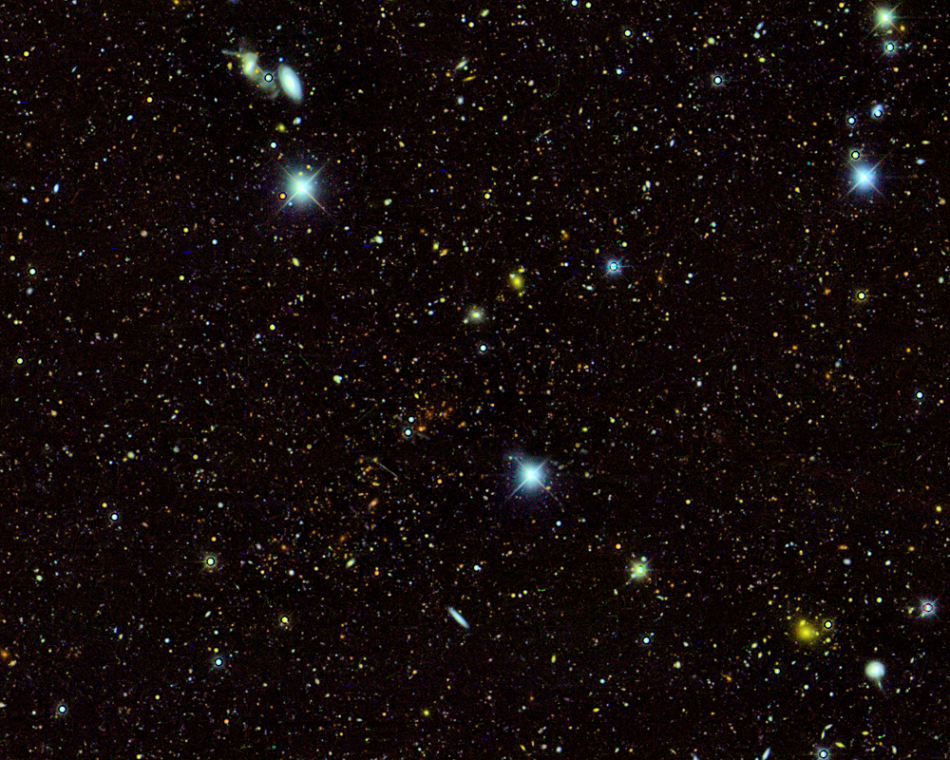
After changing our notion of what a galaxy is and our place in the universe, Hubble set out to categorize the different kinds of galaxies. Pictured above are many types of galaxies captured by the Dark Energy Camera (DECam). There are at least five or six easy-to-spot galaxies – the edge-on spiral on the right side, the pair of colliding spirals at the bottom center, a big spiral in the top-left, and an elliptical on the far left.
Hubble’s discovery rocked astronomy, and as the fields of astronomy and physics inevitably came together, many new questions emerged. Is the universe static? How did the universe come into being? How old is the universe?
Our current understanding is that the universe is not static. Nobel prize-worthy research conducted in the late 1990s used exploding stars (supernovae) to reveal that the cosmos is expanding at an increasing rate. Some new form of energy (dark energy) is overwhelming the force of gravity between all the massive objects in the universe. The fate of the cosmos is once more brought to light.
So what is driving that expansion? What is causing galaxies to move away from one another, overcoming gravity’s pull? The answer appears to be dark energy. Very little is known about dark energy, but we believe it makes up about 2/3 of the energy in the universe.
And so we are at the beginning again. Our answers lead us to new questions. There are many more questions to answer, and many more measurements to make.
If you’re interested in seeing these galaxies for yourself, point your telescope toward RA 05:00:34 Dec -62deg 4’.
Written by Det. Marty Murphy [FNAL]
Image by Det. Marty Murphy
 Dark Energy Detectives