A project of the Dark Energy Survey collaboration

Latest

Image

Roadway to the Heavens: the Signal and the Noise

expters_meeting-7252_20121023_nord_800px

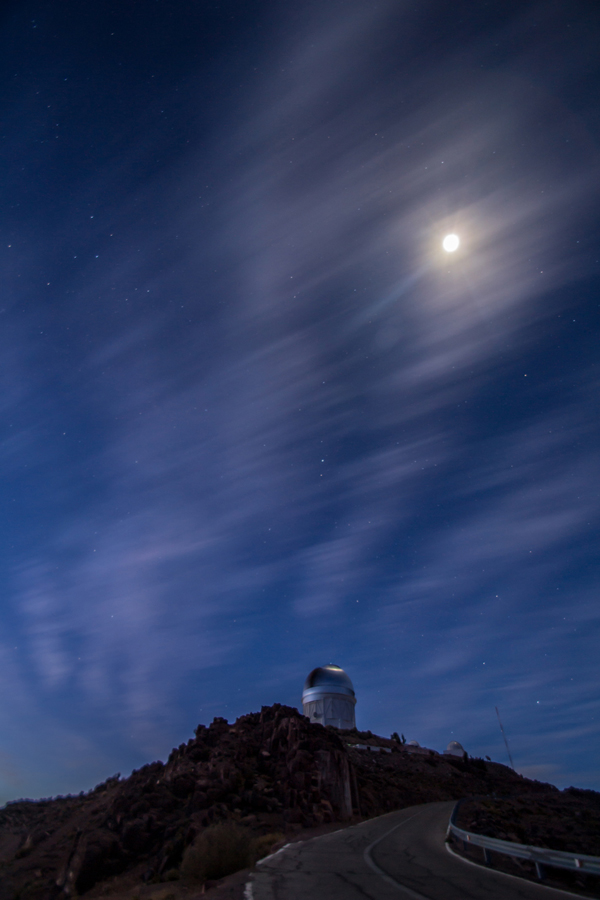
The Sun has long since set, but the Moon keeps its memory alive. In the moonlight, we traverse this short path up to the top of the mountain each night from one of the small houses where we stay for this 10-night astronomical observing stint. Tonight’s drive offers a clear reminder that the path to new knowledge is as winding and uncertain as the roadway to the heavens.

Most nights, clear and dark skies prevail, and the Dark Energy Camera (DECam) has a clean view to the objects in the sky it aims to see. The signals from stars and galaxies arrive unfettered, uninterrupted. Occasionally, however, clouds block light from the celestial sphere, the Moon outshines it and a turbulent atmosphere redirects it. What’s more, the atmosphere itself is constantly at work, emitting light from across the electromagnetic spectrum.

The atmosphere and Moon represent very important sources of noise when observing, especially when incredibly distant and faint objects are the intended targets: DECam is designed to see light from galaxies that are more than 15 billion light-years away. The goal is to get as much signal as possible, while minimizing the effects of all the noise sources, like those mentioned above.

Clouds, like those seen in this week’s image (20-second integration time), block light from stars and galaxies. Less light means less signal. On some nights, the Moon is too bright for the sensitive detectors in DECam, and we have to point the Blanco Telescope away from the moon. Some of the light from the Moon still bounces around the layers of the atmosphere and trickles into the Blanco field of view. Too much scattered light from the Moon or other sources adds to the noise and obscures the signal. Turbulence in the atmosphere deflects light from the objects we seek: multiple layers of air with different temperatures, moving at different speeds heavily disrupt light paths. Consider how the light of a straw is refracted when it goes into a glass of water. This happens in our atmosphere many many times over.

Over the years, astronomers, engineers and climate scientists have worked more and more closely to understand how weather and climate impact astronomical observations. While we’ve come quite far, and we will be able to do exquisite dark energy science at the Blanco, we know there is more road to pave.

Written by: Det. B. Nord [FNAL]
Image Credit: Det. B. Nord [FNAL]
Image

The Ancient Universe, Untouched

Om-Cen Composite

The past can be far, far away, but sometimes it is so close to home. Long ago, the first stars lit up, and hydrogen burned inside them. The hydrogen fused and became helium, which in turn fused into yet heavier elements: through nuclear reactions, the cores of stars birthed all the elements that make up our world. When extremely massive stars with these heavier elements exploded, they sent forth into the universe the stuff that would become new stars, as well as planets, and you and me. These first stars are far away in time and space, but there lives an ancient collection of stars in our galactic backyard that simply grew old slowly and quietly.

Omega Centauri is composed of stars that have elements relatively light in weight—from hydrogen and helium to silicon and neon. However, they are lacking in heavy elements, like iron—the same iron found in our blood and in the steel of our buildings and machines. These stars fused atoms in their cores, but they never grew massive enough to explode, so they just burned on, slowly but surely.

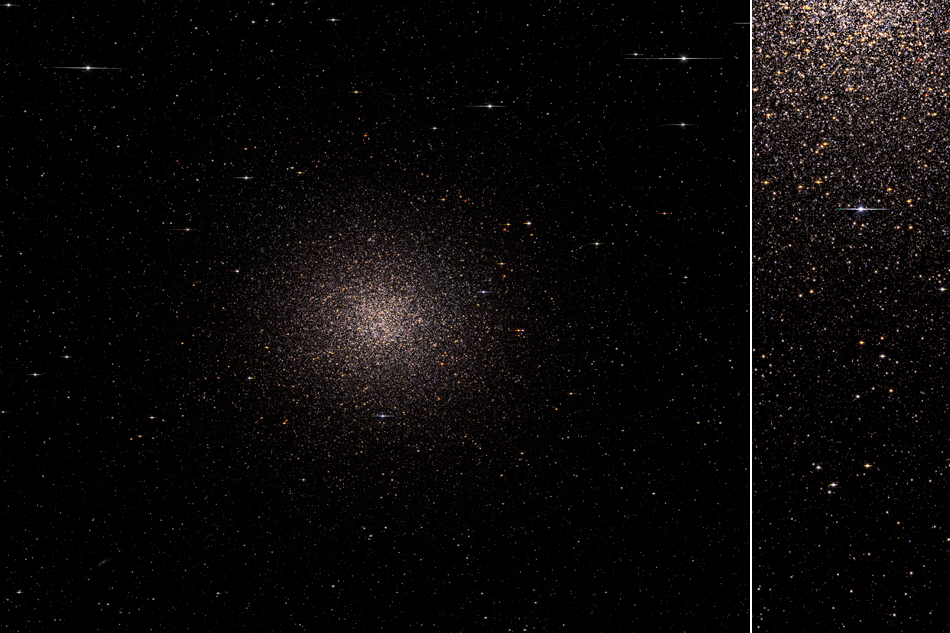
Though Ptolemy cataloged Omega Centauri as a single star 2,000 years ago, it is a dense cluster of several million, very old stars. This globular cluster has been orbiting the Milky Way for 12 billion years, nearly the entire age of the universe. Omega Cen is about 15,000 light-years away from the Galaxy, but just a dozen light-years in diameter itself. What’s more, its millions of stars are separated from each other by just a tenth of a light-year. This is roughly equivalent to a golf ball full of very fine sand sitting at the edge of a football pitch. The nearest star to our solar system is Proxima Centauri, just 4 light-years away—still over 10 times the distance between stars in Omega Cen.

Rediscovered by Edmond Halley (of eponymous cometary fame), Omega Cen (a.k.a., NGC 5139) is a globular cluster located in the direction of the Centaurus constellation. Teeming with millions of ancient furnaces, it is the largest and oldest of the 150 globular clusters orbiting the Milky Way.

Omega Cen is visible with the naked eye and  can appear as large as the full moon.  It lives at Right Ascension, 13 : 26.8 (h:m) and Declination, -47 : 29 (deg:m), should you choose to seek it out yourself.  The image above shows the full cluster in the frame and zoom-in of a small section in the right frame.

Written by: Det. B. Nord [FNAL]
Image Credit: Det.’s M. Murphy and N. Kuropatkin [FNAL]

Image

Fire in the Sky

ctio-0596_20130208_nord

As day gives way to night, our star plummets into the pacific. We refuel our brains for a night of work and then watch the sun scorch the horizon into darkness. This is our nightly ritual.

After dinner, our crew heads back to the telescope. Some of us take a car up the roads, while others make their way up the winding paths through the clay and dirt. Like clockwork, we pass a family of zorros (“foxes”), who often wait outside the kitchen for tasty scraps. There are more mouths to feed now: this past spring, a new litter of pups appeared. Occasionally, a few viscachas (rabbit-like rodents in the chinchilla family) graze on the rare sprig of fauna in the dry mountaintops and then rest on warm rocks in the fading sunlight.

The Dark Energy Survey (DES) observes during these summer months, and the community has priority access to the instrument during the remainder of the year. DES runs optimally during the dry summer (in the southern hemisphere, lasting from December to February) to avoid atmospheric water absorbing and scattering light from the higher-wavelength portions of the electromagnetic spectrum. We desperately need that light to see older, more distant cosmic structures.

On especially dry evenings, a green flash can be seen in the moments before the last of the sun falls below the horizon. Earth’s prismatic atmosphere scatters the suns rays and splits the light by color. As the sun drops, the spread-out spectrum rolls vertically across our eyes, quickly from red to orange and very very briefly through green.

Celestial objects that DES observes set just like the sun does; between the beginning of night and the time a galaxy has fallen below the horizon there is very little time—from minutes to hours.   If the Universe were a year old, humanity has existed for about 20 seconds.  We have but mere fractions of a moment to take snapshots of these galaxies and stars that have lived for millions and billions of years and that reside millions of light-years away. Utterly ephemeral, the green flash reminds us of the difficulty of our endeavor, of the challenge of catching light from billions of objects so distant in time and space from us.

Written by: Det. B. Nord [FNAL]
Image credit: Det. B. Nord [FNAL]

A Dark and Lonely Universe

ngc1090_reduced

It is early in the life of the universe. Cold clumps of inanimate matter are randomly distributed throughout the cosmos. In this randomness, some places have more matter, more stuff, than other places: some regions are denser than others.  Over time – millions and billions of years – the force of gravity causes these dense clumps to accumulate more and more matter, often taking from the already-emptier places. Essentially, when it comes to the growth of structure (from planets to galaxies and all the way up to the largest scales of the universe), the rich get richer, and the poor get poorer.

Fast forward to the present and we can see the results of this evolution.

Some galaxies were born in very rich environments; and while they started blue, today they are red.  These  galaxies, like some we’ve seen in earlier posts, become red because of all the massive stuff running around nearby them, disrupting the formation of their stars.  These red galaxies have come to live in clusters.

Other galaxies that don’t live near a lot of stuff don’t have that problem. They live in the field, and they can still give birth to stars, because other galaxies aren’t whizzing by them. These galaxies will remain blue for a long, long time as they drift along in their lonely, relatively empty piece of the universe.

NGC 1090 is one such field galaxy that lives 135 million light-years from Earth – equivalent to about 1.5 million billion round trips between Earth and the Moon.  It resides in the Cetus constellation and lies near a group of galaxies, M77.  However, NGC 1090 is not gravitationally bound to M77: it is completely unassociated; it is alone.

In the far, far, far future, dark energy may continue to pull objects farther and farther away from each other, and it may do so faster and faster – despite gravity’s attractive force.  Eventually, all galaxies could live in their own lonely regions of the universe.

If you’d like to track down the lonely NGC 1090 yourself, it sits on the celestial sphere at RA (02h 46m 33.9s) and DEC (-00° 14′ 49″)

Written by: Det. B. Nord [FNAL]

Image credit: Det. M. Murphy [FNAL],  Det. N. Kuropatkin [FNAL]

Image

Dark Skies Turned Gray: Working in the Clouds

LIfeInTheClouds_DarkSkiesGraySkies_reduced

We awoke just after two in the afternoon to the eye-itching grogginess that inevitably follows a long night of observing. The afternoon light just barely peeked through the few windows in our dormitory rooms, located more than 60 meters (about 120 feet) below the Blanco Telescope, where we do our nightly work for the Dark Energy Survey (DES).

As we headed to the lunch-flavored breakfast in the cafeteria we spotted a procession of dark clouds to the southeast. To our dismay, the prevailing winds appeared to be carrying them toward us, and toward the Blanco.

During ‘breakfast,’ comprised of tasty fresh vegetables and sausage, we discussed last night’s observations and logistics, as well as plans for the upcoming night, including speculation about the impact of the potentially turbulent weather.

Wet and tumultuous skies scatter the light from distant galaxies and stars that were otherwise on straight paths toward the telescope. This can cause a blurring of images. For telescopes situated on Earth, the higher the mountain-top site, the better the chances of avoiding atmospheric disruptions. The Cerro Tololo Inter-American Observatory resides at about 2200 meters (or 7200 feet) and it enjoys clear, dry skies the vast majority of the time.

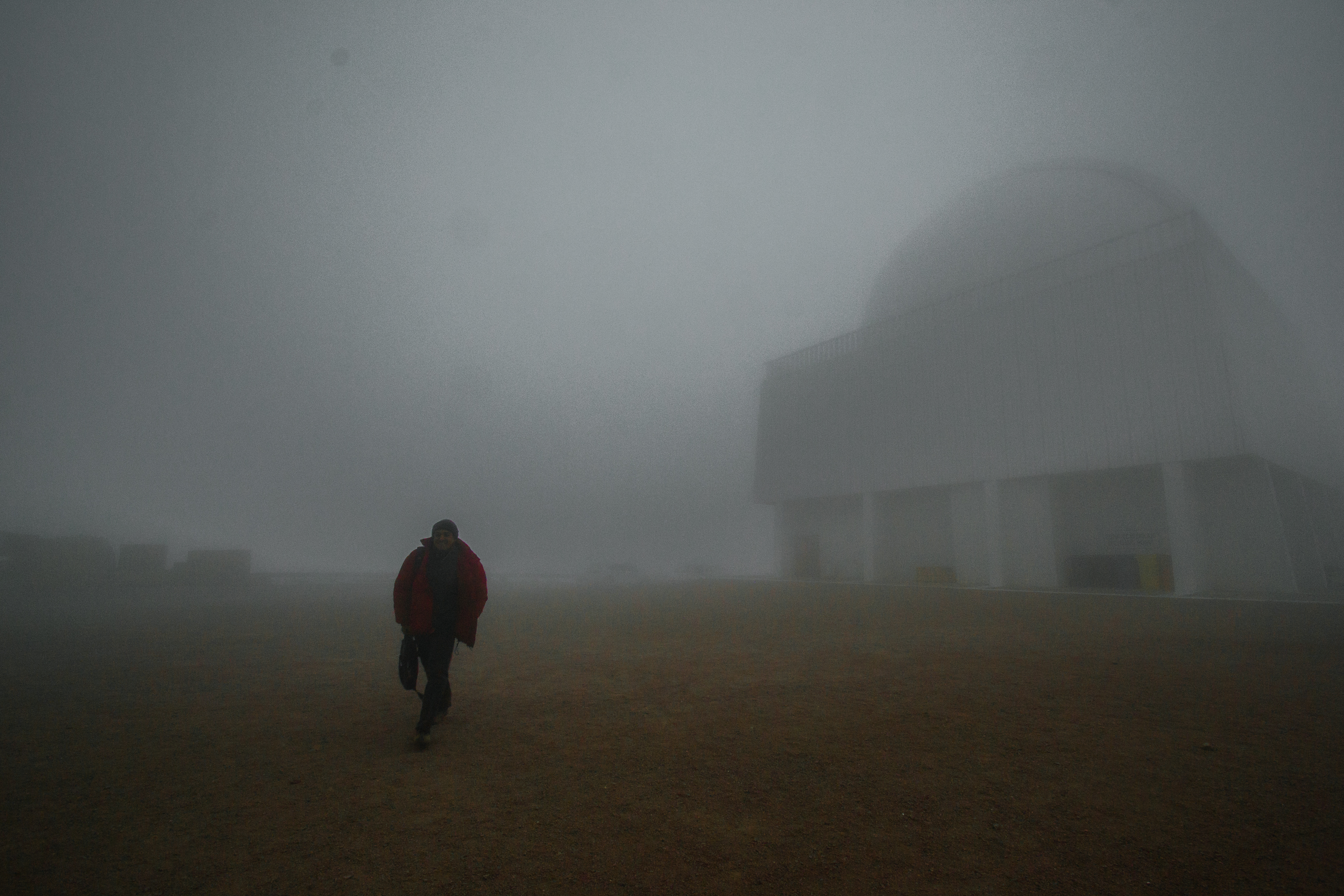
Occasionally, mother nature reminds us of her unpredictability and how precious each photon is. With only eight hours of night out of every 24, we need all the darkness we can get. On this afternoon in the early Chilean spring season, our hopes would succumb to the fickle weather. After lunch, we left the cafeteria and looked up to find that a low-flying cloud had come to rest on the mountain peak, enveloping the Blanco. This night, there would be no sky observations, and no photons would break through this wet, gray blanket.

The picture above is taken looking outward from the main door to the control room of the Blanco. The telescope operator, Claudio Aguilera from La Serena, Chile, arrives for the night’s (uneventful) work.

Written by: Det. B. Nord [FNAL]
Image Credit: Det. B. Nord