A project of the Dark Energy Survey collaboration

Latest

Image

The Shape of Things to Come

rxj2248p.edit5.1

With so many bright lights out there, it’s a veritable surprise when we remember that most of intergalactic space is utterly empty. It contains about 1 particle per cubic centimeter on average.

Amidst the cornucopia of stars and galaxies sits a distant cluster of galaxies that exhibits a very notable behavior.  RX-J2248 (named for the ROSAT X-ray telescope, with which it was discovered) lives at a redshift of 0.35 and has hundreds of red old galaxies, as well as a massive amount of dark matter.

If we zoom in (inset, lower right), we can see the effect that this large amount of matter has on its immediate surroundings and on the fabric of space-time itself. In the center of the inset lies a yellow-ish, beautifully glowing bright central galaxy; this is the hub of RX-J2248. While most of its neighbors shine with a very similar hue, others are as blue as a clear daytime sky. These blue objects are actually distant galaxies, and don’t reside very near the cluster at all. They live far behind it, farther away from us and at higher redshifts.

So how can we see these galaxies? The cluster (galaxies, dark matter and all) has distorted space time: the light will still travel in a straight line, but this straight line is now in curved space. This is similar to how lenses in your eyeglasses distort images and bend the paths of light rays. For this reason, this peculiar phenomenon is called ‘gravitational lensing.’

This image represents the shape of things to come as the Dark Energy Survey gears up to begin its five-year mission. With strong gravitational lenses like RX-J2248, with thousands of supernovae and millions of galaxies and galaxy clusters, we will have the power to explore the nature of dark energy and its impact on our universe.

Written by: Det. B. Nord [FNAL]

Image created by: Nikolay Kuropatkin & Martin Murphy [FNAL]
Image

Star Light, Star Bright

DES12Ca_before-after

Which star can you see tonight?

Stars live out varied and complicated destinies. From the time of birth, a star’s cores house nuclear fusion reactions that combine lighter elements into heavier ones – e.g., hydrogen into helium, and so on. During fusion, light is emitted. From the core of the Sun, to the pupil of your eye, each ray of light takes a one million-year journey, bouncing off hot plasma on its way out of the star.

This burning can continue for tens of millions to billions of years, depending on the mass of the star. When the burning finally ceases, the light no longer pushes its way out, no longer fights the crushing gravity. For some stars, this disruption results in a massive and violent explosion, a supernova. Stellar material, including the heavier elements, like the calcium in your bones and the silicon in our computer chips, is then blasted into the nearby interstellar medium. In this new enriched region of space, a planet or new star may someday grow.

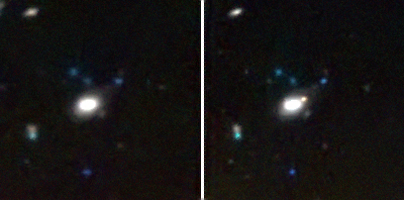
The pair of images above displays a galaxy, far away from our own, before and after a supernova event. Can you spot the difference? Supernovae often outshine their host galaxies. What’s more they can produce more energy in weeks or months than our own Sun can during its entire lifetime of billions of years.

Supernovae are very well understood. We understand them so well, in fact, that we can use them as buoys in the fabric of space-time: they are precise indicators of how much the universe has expanded at different points in its history.

After a year of commissioning and verifying the telescope and new instrument, the Dark Energy Camera (DECam), we will begin to perform a 5-year census of galaxies, supernovae, and other astrophysical phenomena. Analyzing distances of these objects and recovering patterns, the large-scale structure of the cosmos, we will learn about the nature of dark energy and its impact on the fate of the universe.

Disclaimer: the Sun will not explode. But, in a few billion years, it will grow in size and envelope the inner rocky planets… all except Mars.

Written by: Det. Brian Nord [FNAL], Joe Bernstein [Argonne National Lab]
Image by: Martin Murphy [FNAL] and Andreas Papadopoulos [U. of Portsmouth]

Image

Into the Vortex!

12-0333-20D.hr_reduced

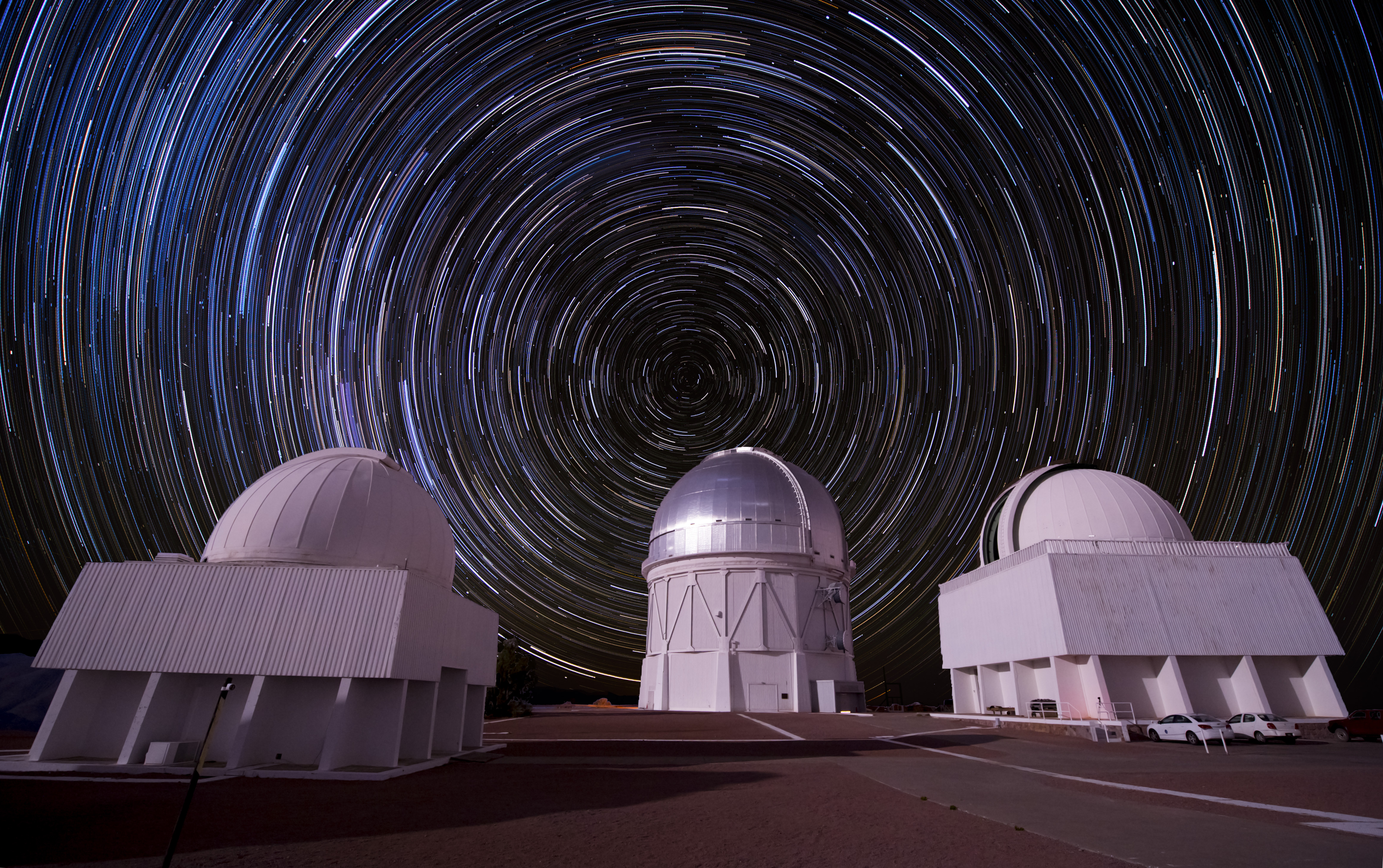
Moonlight illuminates the top-most plateau of the Cerro Tololo Inter-American Observatory (CTIO), near La Serena, Chile—and with it, the Blanco 4-meter telescope dome (middle) that houses the Dark Energy Camera (DECam). Directly above the dome, we see Earth’s south pole, about which the world turns and our celestial sphere rotates, giving us this vortex of starlight.  Peering out of our little blue dot, our little snow globe, we also look into the depths of space and into our universe’s past.

Written by: Det. B. Nord [FNAL]
Image by: R. Hahn [FNAL]

Image

Big Sky, Big Beautiful Machines

11-0003-02D.hr_hahn_reduced

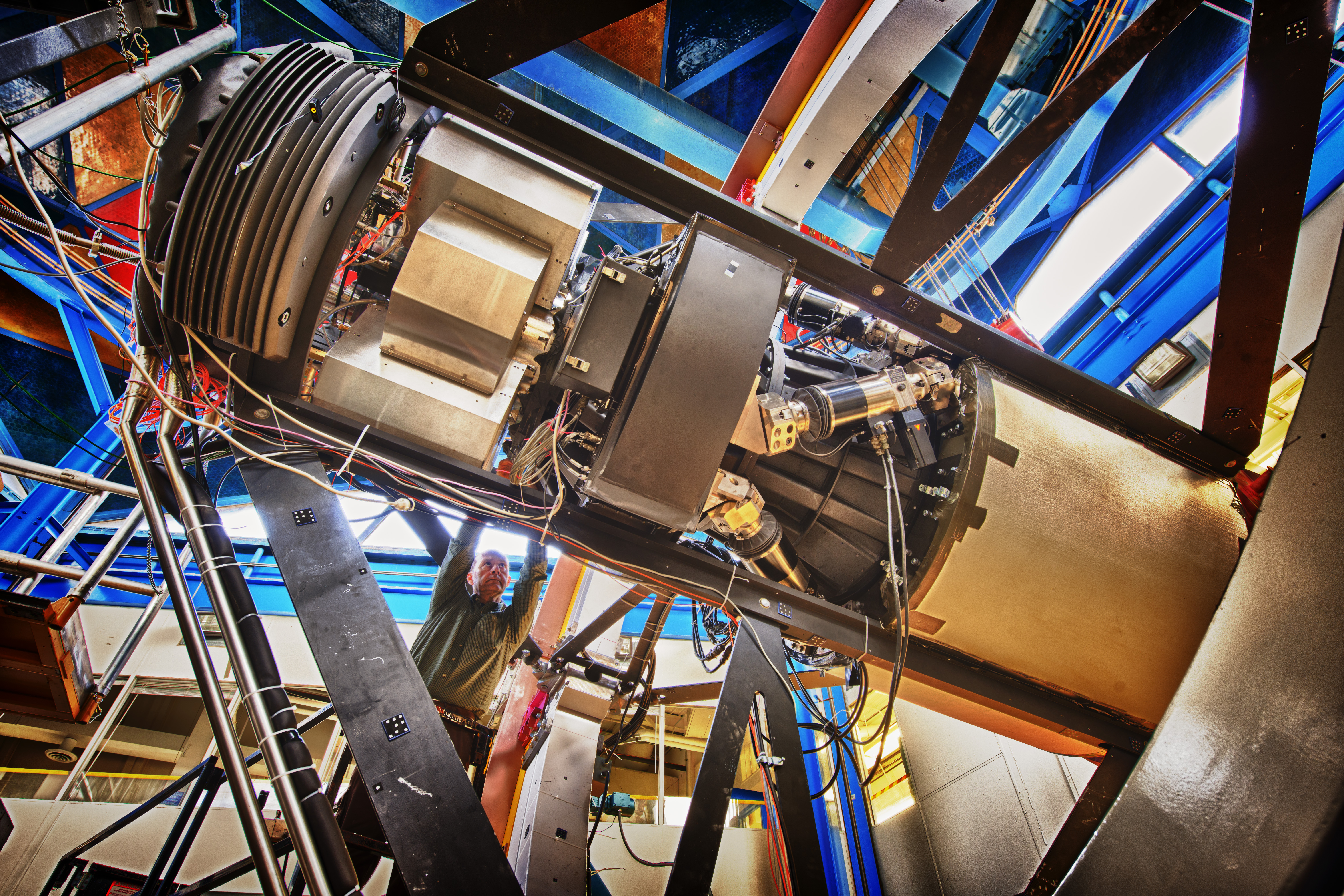
Sometimes, big ideas need really big machines. Here, we see a rare close-up of the Dark Energy Camera (DECam) and most of its components. Over the course of about 10 years, hundreds of scientists and engineers from institutions across the world designed, built and calibrated the major components of DECam—an optical lens barrel, a hexapod, a filter changer, a shutter, CCD sensors and control electronics (from lower right to upper left).

In the image, DECam is not yet actually on the Blanco Telescope, which is in Chile. Before being installed there, it was assembled at the Fermi National Accelerator Laboratory (FNAL) in Batavia, Illinois in a test facility. The operations team performed tests to make sure that the multiple components came together and operated seamlessly before shipping all the components to their final location at the Cerro Tololo Inter-American Observatory (CTIO). Fermilab technician Kevin Kuk works on the last elements of assembly before testing.

As we plunge into a new era of science with big data, the needs for diverse skill sets and efficient communication between many scientists becomes increasingly clear. Last century, a few people around a table could design and create an experiment in a very short time, and with it make astounding discoveries. It is unclear how often this will happen in the future: our biggest questions require so many measurements with such high precision, that we need more and more people to work on them.  Welcome to a new day in science, welcome to the super-collaborative era.

Written by: Det. B. Nord [FNAL]
Image by: Reidar Hahn [FNAL]

Image

Snowflakes

DECam_week11_snowflake_irg

From bright blue spirals to golden and red ellipsoids, our deep night sky is dotted with nearly innumerable unique galaxies, all teeming with stars and planets. We will use their colors, brightnesses, shapes and even how they are distributed throughout the fabric of space-time to uncover the secrets of dark energy. The veritable cornucopia seen in this image is just one example of the pictures we’re taking.

How many galaxies and how many types do you see?  (Galaxies are fuzzy with various shapes, while stars are spherical.)