A project of the Dark Energy Survey collaboration

Latest

Image

River of Dreams

ctio-8471_20130201_950px

The Dark Energy Survey, in its search for distant cosmic secrets, needs many nights of clear sky. Unfortunately, on this night, a river of clouds flowed overhead. We often look so far away to the faintest objects, that a wisping of cottony clouds moving over the Blanco telescope requires extra attention. In these cases, we might change our observing strategy to look at parts of the sky that require less detail.

As we sift through the tons of sediment and the terabytes of data, occasionally the clouds get so heavy and consuming that we must close the telescope dome to preserve the instrument. In these cases, we still use the time wisely: our Dark Energy Calibrations (DECal) team has developed a method to precisely measure and characterize the flow of light through the telescope at every relevant wavelength, and to monitor for any changes in that flow over the years of the survey.

As we fish for light in the sky, we cast a broad net. In the river of dreams, we sift through sediment for celestial gold.

Image

Lights Burning and Churning Through Time

DEC_155469_128-Row5Box6.v1.4.900px

The light is going the distance.

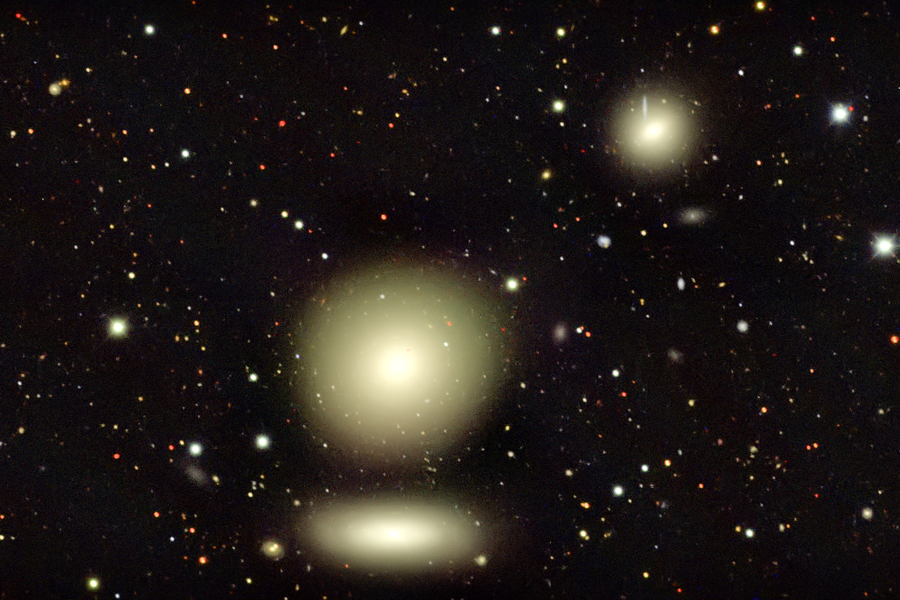
Some celestial (light-producing) objects are farther away than others. The three larger galaxies in today’s image are nearby, located in the Fornax galaxy cluster. As you can see, light comes from other galaxies much farther away: the smaller points are galaxies, too. We measure the patterns in the galaxies that are far away from us and compare that to the patterns of the nearby galaxies. Differences in this pattern give us indispensable clues about how dark energy has affected space-time over the last several billions of years.

And some of the bright points (galaxies) are behind the large galaxy near the center (NGC1374), yet we can see them. What does that tell us about the brightness in different parts of galaxies? If you look closely, we can see background galaxies (those behind) everywhere—except a small patch near the center. This is due to the fact that the centers of galaxies are brighter than their outskirts.

Light from distant regions of space can travel up to billions of light-years, to accidentally land here on Earth — to land on a small spot on the side of a mountain in Chile, where the Dark Energy Camera is waiting to capture it. To measure the expansion of the universe, the Dark Energy Survey needs to measure light from hundreds of millions of galaxies, all differing in their colors, brightnesses and locations. These properties will betray their patterns, which we must decipher.

Light travels the distance, and we’re hunting it all the way.

Written by:   Det. B. Nord [FNAL]

Image by:   Det.’s Nikolay Kuropatkin [FNAL], Martin Murphy [FNAL]

Image

The Cosmos: A Digital Frontier

ded_computing_compositeEver since we started looking up, we tried to picture where the lights in the night were coming from as they moved through the universe. What were these objects – fiery stones, gods?

We kept dreaming about and measuring a world that was hard and too dark to see. And then one day, we could see into its depths.

At first, we only looked out with our eyes, and then we captured light on photographic plates of glass, and then we learned to convert the photons of light into electrical signals that we can store and analyze in computers.

When you sit down at the console, the eight-panel control module first looks like a gamer’s dream. And then you look to your left and you see another multi-panel module. These two consoles alone control the hundreds-ton telescope and $50M Dark Energy Camera (DECam) that captures the light from distant galaxies and exploding stars. These two consoles initiate the process of turning the ancient light into the recorded history of the cosmos. But if you want to know what goes on inside the machines, how we cyber crunch the sky, you have to look behind the scenes at the Data Management system that turns photons into bytes.

The Dark Energy Survey (DES) acquires hundreds of images – nearly a Terabyte of data – every night, and will continue to do so for the next five years. After the light is collected and stored, it must be transferred and cleaned before we can mine it for the faint clues of dark energy. As the images are taken, they are transferred via a high-speed pipeline from the mountaintop of Cerro Tololo in Chile to the corn fields of Illinois, where computer clusters at the National Center for Supercomputing Applications (NCSA; image, upper left) perform calibrations and tests to ensure data are free of error and contamination, to prepare them for cosmological analyses.

While we can observe and measure the sky to great depths, a key partner in this endeavor is our theoretical understanding of cosmic evolution. For this, we must create fake universes, with a variety of different parameters, inside these super-computers. DES will simulate several universes, in which we will test the hundreds of thousands, millions of lines of code in preparation for working with actual data. What’s more, we can compare the simulated universe to our own, telling us which aspects we’ve simulated correctly and which parts of our theories are solid, which need revision. Super-computers, like those at NCSA shown in today’s image (top right and bottom), play a critical role in constructing these universes.

It’s amazing how productive watching the sky can be.  But, to look out, we had to bring the universe in.

(Hat tip to Tron: Legacy.)

By: B. Nord [FNAL]

Image: NCSA

Image

Hotel Tololo

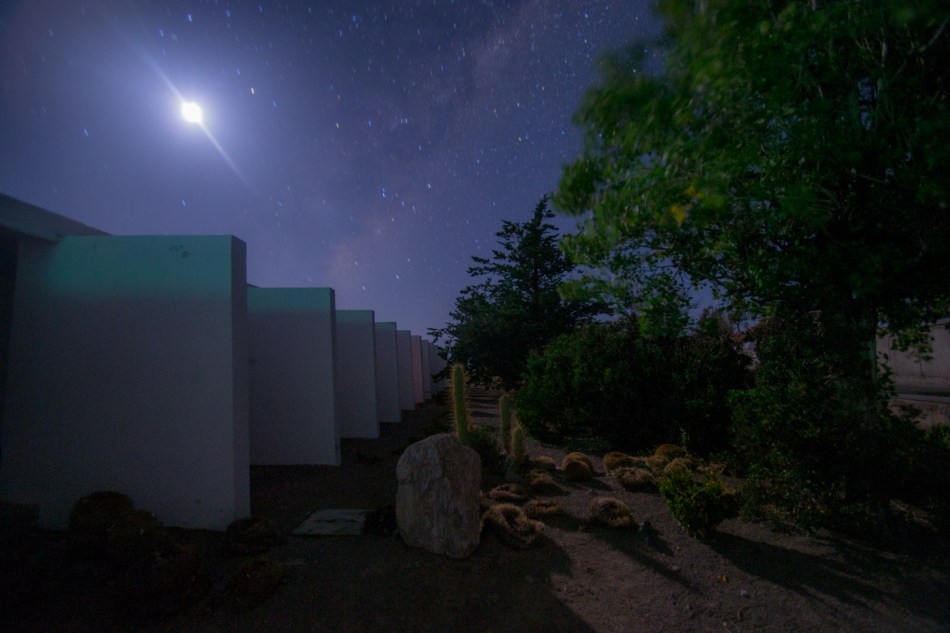
ctio-9717_20130205The dormitory rooms at the Cerro Tololo Inter-American Observatory (CTIO) in Chile cast a stout shadow over the desert fauna in the light of the early risen moon last February. This night’s moon is so bright, it prevents the Dark Energy Camera from looking at that part of the sky. On bright nights like these, we aim the telescope elsewhere, but still looking, still searching for supernovae and distant galaxies.

We start the night’s work early with an inter-continental tele-conference before dinner.  After dinner, we prepare the software and telescope until sunset, when the hunt begins. Working through the night (and through a few pots of coffee and bags of cookies), we emerge a few hundred images closer to understanding dark energy and its effects on the celestial objects deep in the night sky. Just after sunrise, we hit the hay, but our minds often keep crunching numbers or sifting puzzles that arose during our observations, as the work from our night bleeds into our dreamscape.

Welcome to Hotel Tololo. We’ll turn the light off for you.

Written by: Det. B. Nord [FNAL]

Image by: Det. B. Nord

Image

360,000 Minutes … How Do You Measure the Sky

DECAM_v1

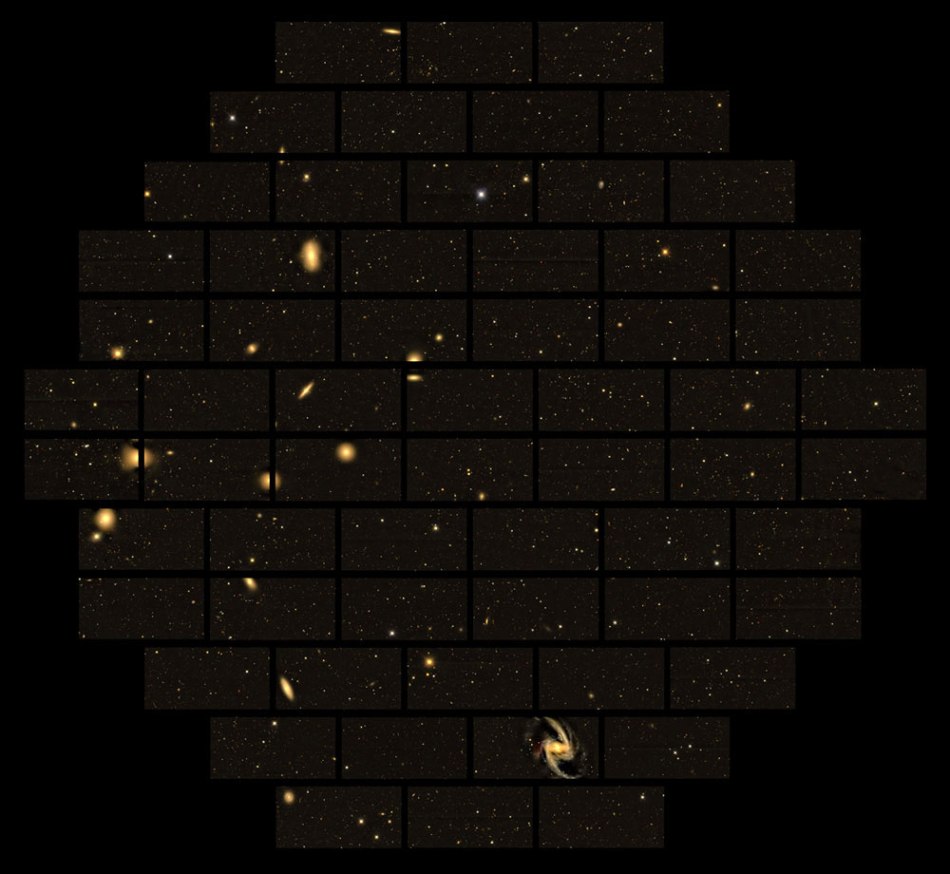
On August 31, 2013, the Dark Energy Survey (DES) began its exploration of new realms of the observable universe. For about 100 nights per year, during the next five years, the Blanco Telescope in Chile will scan the sky using the newly commissioned Dark Energy Camera. With 62 highly sensitive detectors (containing about 500 million pixels), DECam will collect light from hundreds of millions of galaxies and thousands of supernovae from billions of years ago, their light leaving faint traces of a cosmos expanding ever faster. Whether the cause is a mysterious dark energy or a change in our understanding of gravity, DES endeavors to discern the nature of our accelerating universe.

We spent the last year commissioning the telescope and camera, performing calibrations and tests to make it science-ready. The 62 detectors are shown in today’s image, taken from one of last year’s preparatory observations. Clicking on this image will take you to an interactive page where you can zoom in on each chip and look at what DES scientists see after each picture of the sky is taken.  We will gather thousands of images like this in the coming years.

We now begin a new journey, with many seasons of discovery ahead of us: in photons, after sunsets, past midnight, with lots of coffee… In pixels, in light-years, that’s how we measure the sky.

Written by: Det. B. Nord [FNAL]

Image by: Nikolay Kuropatkin [FNAL], Martin Murphy [FNAL]